
Determining Vehicle Speed from Video: A Texas Crash Reconstruction Guide


By R. Ryan Rider, Ph.D.Crash Reconstructionist | Triple R Investigations, LLC
Introduction: Can Video Evidence Reliably Establish Vehicle Speed?
A vehicle approaches an intersection. Seconds later, a collision occurs. A nearby business surveillance camera captures the incident, while another driver records the crash with a dashboard camera.
During the subsequent investigation, attorneys receive the recordings. One party claims the vehicle was traveling 45 mph, while another alleges it was traveling more than 70 mph. In this hypothetical situation, can the video establish which speed estimate is correct?
The answer depends on more than watching the footage or counting the number of frames between two locations. Digital video has become an increasingly valuable source of evidence in traffic crash reconstruction, with surveillance systems, dashboard cameras, smartphones, commercial vehicle cameras, and traffic monitoring systems potentially capturing critical portions of a collision sequence. However, these recordings introduce technical challenges that can significantly influence speed calculations.
A video recording may show how a collision developed, but determining vehicle speed requires more than observing movement across a screen. The reconstructionist must establish that distance traveled and elapsed time can be measured reliably. Without that foundation, a calculated speed may be mathematically correct but scientifically unsupported.
The National Highway Traffic Safety Administration (NHTSA) reported that 11,288 people died in speeding-related traffic crashes in 2024, accounting for approximately 29% of all traffic fatalities. These statistics show the significance of speed in traffic safety, although speeding-related fatalities should not be interpreted as proof that speed independently caused every collision. Establishing vehicle speed can be important when investigating collision causation, evaluating driver conduct, and assessing potential avoidability.
For attorneys handling serious injury, wrongful death, and disputed liability cases, the critical distinction is between a speed estimate that appears reasonable and one supported by a scientifically defensible methodology. This article examines how forensic video analysis supports vehicle speed determination, the technical limitations affecting accuracy, and the questions attorneys should consider before relying on video-based reconstruction opinions.
How Video Evidence Is Used to Calculate Vehicle Speed
At its foundation, vehicle speed represents distance traveled over a measured period. The familiar equation is:
Speed = Distance ÷ Time
In conventional crash reconstruction, distance may be measured using roadway evidence, metrology equipment, or documented vehicle positions. Video introduces another measurement source: the movement of a vehicle between identifiable locations. For example, a surveillance recording may show a vehicle traveling between two roadway features separated by a known distance.
If investigators can reliably establish the vehicle's position at two points and determine the elapsed recording time, they may calculate its average speed over that interval. The reliability of the result depends on the accuracy of the underlying measurements and the assumptions used to interpret them.
The basic analytical process involves:
Identifying the vehicle and its direction of travel.
Establishing measurable reference locations.
Determining vehicle position relative to those locations.
Verifying the elapsed time between observations.
Calculating speed and evaluating measurement uncertainty.
Comparing the result with independent evidence.
Although the equation is simple, obtaining reliable measurements of distance and time is often the most difficult part of the analysis. The Scientific Working Group on Digital Evidence (SWGDE) has published technical guidance addressing frame timing, video analysis, and photogrammetric measurements. These documents provide important considerations for evaluating the reliability of speed calculations derived from recorded imagery.
Frame Rate and Timing Accuracy: Why Every Frame Matters
Understanding Frames per Second
Digital video represents a sequence of images captured and encoded over time. Frame rate generally describes the number of images recorded or presented during a given second, commonly expressed as frames per second (FPS). However, the rate reported by a video file does not necessarily establish when each image was originally captured.
Forensic analysis must account for the distinction between recording behavior, encoded frame timing, and playback characteristics. The following table illustrates nominal frame intervals under constant frame rate conditions.
Recording Rate | Nominal Interval Between Frames |
5 FPS | 0.200 seconds |
10 FPS | 0.100 seconds |
15 FPS | 0.0667 seconds |
30 FPS | 0.0333 seconds |
60 FPS | 0.0167 seconds |
These intervals assume that consecutive frames represent evenly spaced moments in time. A recording operating at a constant 30 FPS would nominally provide one frame approximately every 0.0333 seconds.
At 60 mph, a vehicle travels approximately 88 feet per second, meaning it would cover nearly 2.93 feet during a nominal 30 FPS recording interval. This demonstrates how even relatively small timing errors can influence vehicle position measurements and the resulting speed calculation. When a vehicle is moving at highway speed, an incorrect assumption involving only a few frames may produce a meaningful difference in the calculated speed.

Constant Versus Variable Frame Rates
Not every recording maintains consistent intervals between frames. Some surveillance systems use variable recording rates or change recording behavior based on system configuration, motion detection, available bandwidth, or other operating conditions. Recordings may also contain duplicated frames, missing frames, irregular presentation intervals, or interruptions.
An important distinction exists between the number of frames displayed and the actual elapsed recording time. A file reporting an average frame rate of 30 FPS does not necessarily establish that every consecutive frame represents exactly 1/30 of a second of real-world elapsed time.
SWGDE's Best Practice for Frame Timing Analysis of Video Stored in ISO Base Media File Formats, Version 1.1, explains methods for examining encoded timing information.
However, the guidance also identifies an important limitation: analyzing timing information contained within a file does not independently establish the reliability of the recording device that generated it.
This distinction is particularly important in forensic reconstruction because an examiner may accurately determine the presentation timestamps associated with individual frames while still needing to evaluate whether those timestamps reliably represent the original recording interval. Consequently, a defensible speed calculation should use appropriately verified timing information rather than simply assuming the reported average frame rate is accurate.
Why Timestamps Can Be Misleading
A surveillance recording may display a date and time in the corner of the image, but that information does not necessarily establish the precise capture time of every frame. The recorder's internal clock may be inaccurate, different cameras may operate with different clock settings, and exported files may contain timestamps that differ from the original recording information.
Investigators must distinguish among the actual time of an event, the recording system's displayed clock time, the elapsed interval between recorded images, and the timing represented by an exported file. Each measurement serves a different purpose, and confusing them may lead to incorrect conclusions about vehicle movement or the sequence of events.
For example, a surveillance camera could display a clock that is several minutes behind the correct time while still recording images at consistent intervals. In that situation, the incorrect displayed clock would affect synchronization with other evidence, but it would not necessarily invalidate the measured elapsed time between frames from that camera. By contrast, a recording system that produces irregular or inaccurately represented frame intervals could directly affect a calculated speed.
These are different technical problems and should not be treated as interchangeable, particularly when combining recordings from multiple cameras to reconstruct a collision sequence. SWGDE's Considerations for the Use of Time-Based Analysis of Digital Video for Court, Version 1.0, addresses the importance of understanding playback timing and the potential for incorrect interpretation when digital video is presented in legal proceedings.
Camera Perspective and Lens Distortion Affect Distance Measurements
Why Vehicles May Appear to Change Speed
Consider a fixed surveillance camera overlooking a roadway. As a vehicle approaches the camera, its apparent movement across the image may increase, while its apparent displacement may decrease as it travels farther away. This does not necessarily indicate that the vehicle changed speed, but may instead result from perspective projection.
Objects farther from the camera occupy fewer pixels than equally sized objects positioned closer to the camera. Consequently, pixel displacement cannot automatically be converted into roadway distance using one uniform scale. Applying an incorrect scale can introduce substantial measurement errors, particularly when the vehicle changes position relative to the camera.
Camera angle, field of view, mounting height, roadway grade, and vehicle trajectory must therefore be considered when interpreting movement. The practical concern is that a vehicle traveling at a constant speed may appear to cover very different pixel distances during successive recording intervals. Without accounting for camera geometry, an examiner could incorrectly interpret that apparent movement as acceleration or deceleration.

Lens Distortion and Wide-Angle Cameras
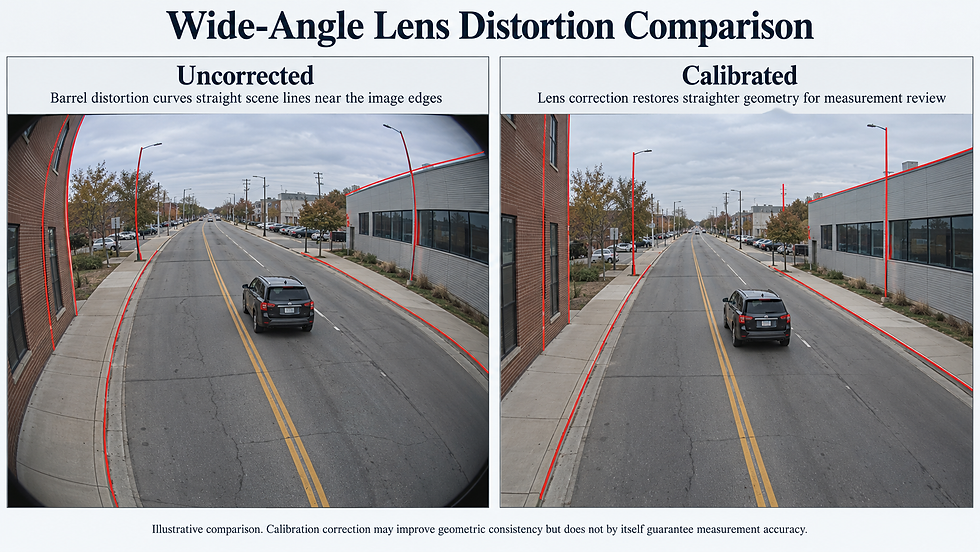
Dashboard cameras and surveillance cameras frequently use wide-angle lenses that capture more of the surrounding environment but may introduce geometric distortion. Barrel distortion, for example, can cause straight lines to appear curved, particularly near the edges of an image. If a reconstructionist measures vehicle movement directly from distorted imagery, the calculated distance may not accurately represent movement within the physical roadway environment.
When appropriate, analysts can employ camera calibration and distortion correction methods to address these effects. However, applying a generic correction without establishing the camera's actual optical characteristics may introduce additional error. The examiner must determine whether the selected methodology adequately accounts for the camera's imaging characteristics.
Moving Cameras Introduce Additional Complexity
A stationary surveillance camera and a moving dashboard camera present different analytical problems. With a stationary camera, investigators may establish reference points within the roadway scene and evaluate vehicle movement relative to those fixed locations. With a moving camera, the apparent movement of another vehicle reflects both the subject vehicle's motion and the recording vehicle's motion.
A reliable analysis may require camera motion estimation, roadway geometry, independently documented vehicle movement, or other supporting information. Simply tracking another vehicle across a moving dashboard camera image does not necessarily establish its ground speed.
For example, a vehicle traveling alongside a dashboard camera at approximately the same speed may show relatively little movement within the image. That does not mean the vehicle is stationary, and the analysis must distinguish relative movement from movement within the physical roadway environment.
SWGDE's Best Practices for the Forensic Use of Photogrammetry, Version 1.2, discusses geometric measurements and the limitations of drawing dimensional conclusions from photographs and video.
Reference Dimensions: Connecting Video to the Physical Roadway
One of the most important requirements in video-based speed analysis is establishing accurate physical measurements. A reconstructionist may identify roadway features visible within the recording, including lane markings, intersections, curb lines, signs, or fixed structures. However, familiar dimensions should not automatically be treated as verified measurements.
For example, lane width may vary depending on roadway design and location, while pavement markings may not conform precisely to assumed dimensions. An investigator who relies on an assumed 12-foot lane width without verifying that dimension introduces a measurement assumption that may affect the entire analysis.
When practical, investigators should measure relevant locations directly using total stations, laser scanners, photogrammetry, or other metrology methods. Three-dimensional laser scanning can be particularly valuable because it documents roadway geometry and spatial relationships that may be used to evaluate camera position and reference measurements. However, the quality of those measurements also depends on instrument performance, registration accuracy, scene coverage, and the documentation procedures used.
For additional discussion, see TRI's technical article, 3D Scanner Use in Crash Scenes.
The stronger the connection between image measurements and verified physical dimensions, the more defensible the resulting spatial analysis becomes. This is particularly important when the camera has been removed, the roadway has changed, or the investigator is attempting to reconstruct measurements from evidence collected by someone else.
How Photogrammetry Supports Video-Based Speed Analysis
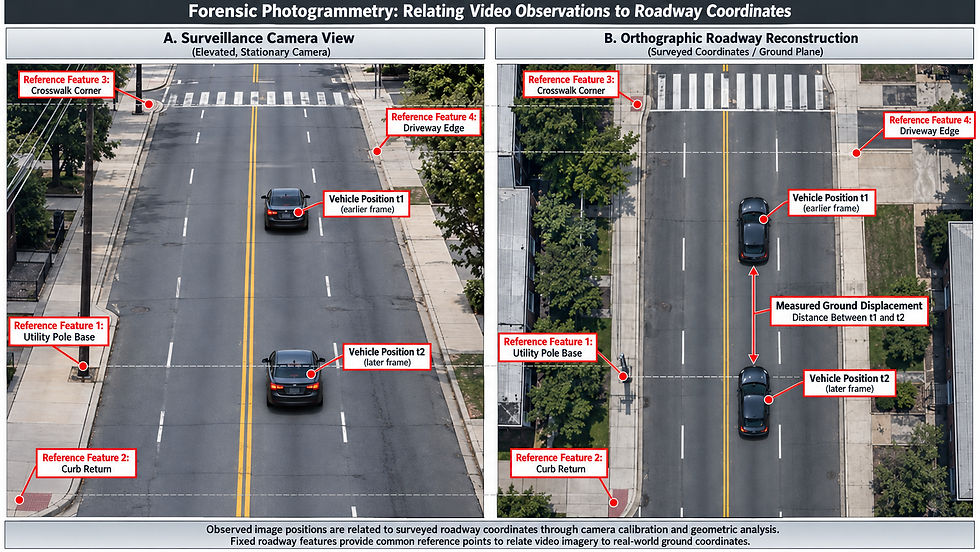
Photogrammetry involves obtaining measurements from photographs or recorded imagery using established geometric principles. In crash reconstruction, photogrammetric methods may help determine where a vehicle was positioned within the roadway at particular moments. Depending on the recording, analysts may use camera calibration, surveyed reference points, perspective transformation, reverse projection, or three-dimensional scene modeling.
A planar perspective transformation can be useful when the relevant measurements lie on a common roadway plane. However, this assumption may be inappropriate when roadway elevation changes significantly or when points above the roadway are incorrectly treated as ground-level measurements.
For example, a point on a vehicle's roof does not occupy the same physical plane as the roadway. If that point is projected onto the road without accounting for its elevation and camera perspective, its calculated position may be incorrect. Similarly, roadway curvature, changing grade, or uneven terrain may require a more sophisticated geometric model.
The analytical process generally involves identifying physical reference features, measuring their locations, establishing their corresponding positions within the recording, and determining the camera geometry necessary to relate image coordinates to roadway coordinates. Vehicle positions can then be estimated at selected recording times, and the resulting displacement measurements are combined with verified timing information to calculate speed.
Where possible, the methodology should be tested against independently measured distances, known dimensions, or other suitable validation information. SWGDE recommends that forensic photogrammetric examinations document the analytical methodology, relevant assumptions, and limitations affecting the resulting measurements.
Photogrammetry can provide valuable measurements, but it does not automatically make every recording suitable for determining vehicle speed. The examiner must establish that the available reference dimensions, camera geometry, and image quality support the intended measurement. The presence of a measurable image does not guarantee that the underlying physical dimensions can be recovered with sufficient accuracy.
Video Compression and Image Quality: Hidden Sources of Error
Digital video compression reduces file size by encoding image information more efficiently. Although compression makes video storage and transmission practical, it may reduce the clarity of features needed for precise measurements. Potential problems include blocking artifacts, blurred edges, reduced resolution, and the loss of fine visual detail.
Compression can make identifying the exact position of a vehicle's bumper, tire contact area, or another tracking feature more difficult. Additional problems can occur when a recording is converted or transmitted through another application, particularly when the resulting file undergoes additional processing.
For example, an attorney may receive a video downloaded from a messaging platform rather than the original surveillance recording. That copy may have different resolution, frame timing information, or compression characteristics. The recording may still provide useful information about the collision sequence, but the examiner must evaluate whether it retains the technical information necessary for a speed calculation.
SWGDE's Best Practices for Digital Forensic Video Analysis, Version 2.0, addresses examination procedures, file characteristics, documentation, and the technical considerations associated with forensic video analysis. For this reason, attorneys should obtain the most original recording available, including native or proprietary files and associated playback software when necessary.

What Attorneys Should Preserve Before Requesting Video Speed Analysis
One of the most important decisions in a video-based reconstruction may occur before the reconstructionist receives the evidence. Consider an attorney evaluating a collision captured by a commercial surveillance system after an opposing expert has already calculated vehicle speed from the recording. The attorney now needs to determine whether that calculation can be independently reproduced.
However, the available recording may be a converted copy rather than the original file produced by the surveillance system. Although it may accurately depict the collision sequence, it may no longer contain the timing information or image quality necessary to verify the opposing expert's calculations. This creates an evidentiary problem that may be difficult to resolve after the original evidence has been lost.
The preferred approach is to preserve the original digital evidence as early as practical, consistent with applicable legal authority and preservation obligations. SWGDE's Best Practices for Data Acquisition from Digital Video Recorders, Version 1.4, addresses the collection of native recordings, associated data, and documentation of the recording system. It also recognizes that digital recordings may be overwritten or otherwise lost if they are not acquired promptly.
Attorneys should consider preserving or obtaining the following materials when available:
Original video files: Native or proprietary recordings, including the relevant period before and after the collision.
Recording system information: Camera manufacturer, model, recording settings, and available system documentation.
Playback software: Proprietary viewers or codecs necessary to examine the recording without unnecessary conversion.
Export information: Documentation showing how the recording was retrieved, copied, or converted.
Timing information: Recording settings, displayed timestamps, known clock offsets, and information needed to evaluate synchronization.
Camera and roadway documentation: Camera location, mounting height, orientation, roadway geometry, and measurable reference features.
Evidence handling records: Information concerning collection, transfers, file integrity, and chain of custody.
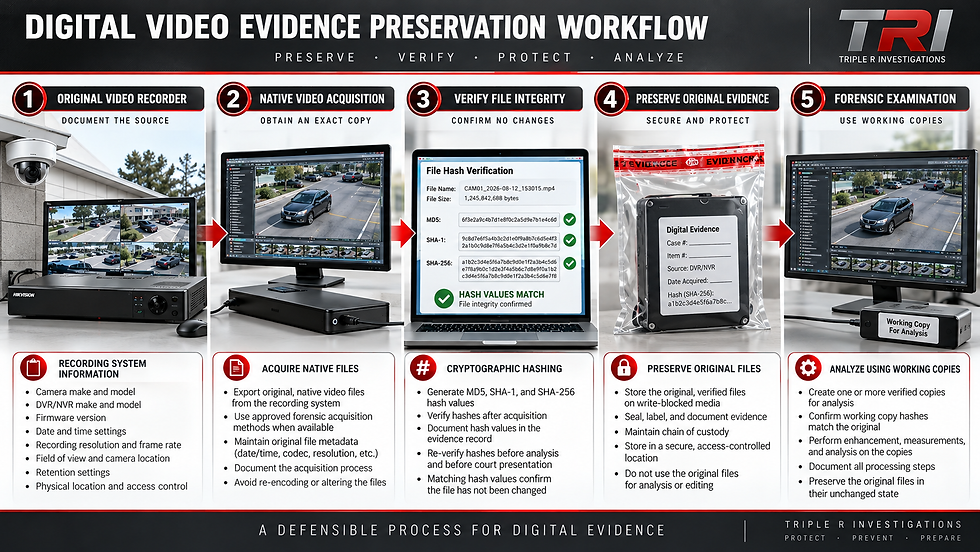
Where appropriate, cryptographic file hashes can assist in demonstrating that acquired digital files have not changed after collection. An examiner should also preserve the original evidence separately from any working copies used for analysis.
Attorneys should not assume that a surveillance recording will remain available indefinitely. Many systems automatically overwrite stored video after a designated period or when available storage capacity is reached. Once the original recording has been overwritten, later recovery may be impossible, making an early technical review important when identifying evidence that should be preserved.
Calculating Vehicle Speed: A Practical Example
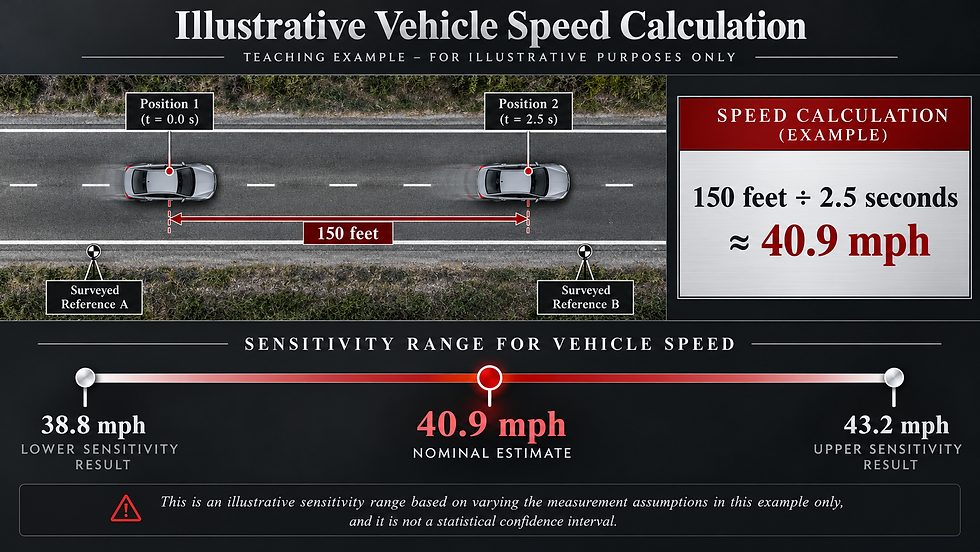
Consider a hypothetical collision investigation involving a surveillance camera overlooking a straight roadway. After evaluating camera geometry and measuring reference locations, a reconstructionist determines that a vehicle traveled approximately 150 feet during 2.5 seconds of verified recording time.
The calculation is:
150 feet ÷ 2.5 seconds = 60 feet per second
Converting to miles per hour:
60 × 0.6818 = 40.9 mph
The vehicle's calculated average speed over that interval is approximately 40.9 mph. However, the analysis should not end with the mathematical result because the reliability of that number depends on the underlying measurements.
Suppose a preliminary sensitivity analysis indicates that the traveled distance could range from 148 to 152 feet and the elapsed time from 2.4 to 2.6 seconds. Using the extreme combinations produces the following results:
Calculation | Result |
150 feet ÷ 2.5 seconds | 40.9 mph |
148 feet ÷ 2.6 seconds | 38.8 mph |
152 feet ÷ 2.4 seconds | 43.2 mph |
Under these hypothetical assumptions, the possible calculated values span approximately 38.8 to 43.2 mph. This is an illustrative sensitivity range, not a statistically derived confidence interval or a validated case conclusion.
The example considers only the assumed distance and timing variations. A complete forensic uncertainty assessment must also evaluate whether other measurement errors, systematic biases, or dependencies between variables materially affect the calculated speed.
Reporting a precise mathematical result does not establish that the underlying measurements are equally precise.
Importantly, the calculated speed represents average speed across the measured interval and should not automatically be described as impact speed or instantaneous speed. That distinction matters when a vehicle may have been braking, accelerating, or changing direction during the measured period.
Real-World Case Study: The NTSB's Philadelphia Interstate 95 Investigation
A useful example of video-based speed analysis comes from the National Transportation Safety Board's investigation of a June 11, 2023, commercial vehicle crash in Philadelphia, Pennsylvania. The collision involved a tractor-trailer transporting approximately 8,500 gallons of gasoline.
As the vehicle traveled along the Cottman Avenue exit ramp from northbound Interstate 95, it entered a decreasing-radius curve, overturned, and struck a concrete barrier. A subsequent fire contributed to the collapse of the northbound Interstate 95 overpass. The NTSB published its findings on March 19, 2025, in Report HIR-25-01, Combination Vehicle Rollover, Fire, and Interstate 95 Overpass Collapse, Philadelphia, Pennsylvania.
How Investigators Used Surveillance Video
The Pennsylvania State Police obtained surveillance footage from a nearby business that showed the truck traveling along the exit ramp before overturning. The NTSB subsequently conducted a video and vehicle performance study to evaluate the truck's speed and the potential effectiveness of electronic stability control.
Investigators examined approximately five seconds of surveillance footage preceding the truck's entry into the curve. The first portion of the study used camera tracking software to analyze the truck's movement relative to identifiable landmarks within the environment. The study also incorporated vehicle dynamics simulations to evaluate how the truck would have responded under different conditions.
The Calculated Speed Range
The NTSB reported that the truck was traveling between approximately 44 and 54 mph at the time of the crash. The exit ramp had a posted advisory speed of 25 mph, meaning the estimated speed range was substantially higher than the advisory speed.
The investigation also evaluated whether electronic stability control could have prevented the rollover. Using vehicle dynamics simulations, the NTSB determined that the addition of electronic stability control prevented rollover across the evaluated 44 to 54 mph speed range. The investigation illustrates how video-based speed estimates can be incorporated into a broader technical evaluation involving roadway geometry, vehicle dynamics, and collision causation.

What This Investigation Demonstrates
Several aspects of this investigation are relevant to attorneys evaluating video-derived speed opinions. The NTSB did not rely solely on the apparent movement of the truck across a computer screen, but instead evaluated vehicle movement relative to physical landmarks. Investigators also reported an estimated speed range rather than a single numerical value.
The speed analysis was considered within the broader investigation, demonstrating how video evidence can contribute to conclusions involving vehicle dynamics and collision causation. This approach illustrates why video-based speed estimates should be evaluated alongside other relevant reconstruction evidence rather than treated as isolated findings.
Error, Uncertainty, and the Limits of Video-Based Speed Estimates
Every physical measurement contains some degree of uncertainty. In video reconstruction, uncertainty can arise from camera calibration, roadway measurements, vehicle position identification, frame timing, synchronization, lens distortion, image resolution, compression, and assumptions about vehicle movement. These sources may produce random variation, systematic bias, or both.
A responsible reconstructionist should identify material sources of uncertainty, determine their potential influence on the result, and explain the limitations of the analysis. Depending on the available evidence, the result may support a numerical speed range, a qualified estimate, or only a broader conclusion about movement and timing.
Some recordings may not support a reliable speed calculation at all. For example, a recording showing a vehicle for only a few frames may establish the vehicle's presence but provide insufficient information for an accurate determination of speed. Likewise, a recording may contain sufficient image quality to identify the vehicle while lacking the spatial references necessary to determine its movement through the roadway environment.
The examiner must distinguish between what the video visibly depicts and what can be established through measurement. This distinction is particularly important when an apparently clear recording creates an expectation that precise reconstruction calculations should be possible.
Speed Is Not the Same as Collision Causation
Attorneys should also distinguish between measuring vehicle speed and establishing collision causation. A vehicle's speed may be accurately estimated without establishing when a hazard became recognizable or whether the driver could reasonably have avoided the collision.
For example, a video analysis might establish that a vehicle was traveling approximately 65 mph before a nighttime collision. That result may be important, but it does not independently establish when a stopped vehicle, pedestrian, or other roadway hazard became sufficiently visible for the approaching driver to detect and recognize it.
The reconstructionist must also consider the developing visual environment, available sight distance, perception-response considerations, and the time and distance available for an appropriate response. A speed estimate becomes more useful when its relationship to the collision sequence can be examined.
For additional discussion, see TRI's Pedestrian Crash Reconstruction: Visibility, Speed, and Avoidability Analysis.
What Attorneys Should Expect From a Defensible Video Analysis
When evaluating video-based reconstruction opinions, attorneys should look beyond the final speed estimate. A technically defensible analysis should explain how the examiner reached the conclusion and whether another qualified analyst could independently evaluate the methodology.
The examination should identify the recording used, explain the methods employed to establish distance and time, describe the assumptions necessary for the calculations, and address relevant sources of measurement uncertainty. Counsel should also determine whether the analysis can be reproduced using the identified evidence and documented methodology.
The examiner should explain any material differences between the original recording and the version used during analysis. Where possible, the conclusion should be compared with independent evidence, such as vehicle event data, physical roadway evidence, other recordings, or documented vehicle dynamics.
A report that provides only a final numerical speed without explaining the underlying methodology may be difficult to evaluate independently. The fact that a reported speed appears reasonable does not establish that the analytical methods supporting it are reliable.
The question is whether the available evidence and analytical methods support that conclusion.
This becomes particularly important when competing experts reach materially different estimates from the same recording. In those circumstances, a detailed review of camera geometry, timing assumptions, reference measurements, and calculation procedures may help identify why the opinions differ.
Texas Expert Testimony and the Reliability of Video-Based Reconstruction
In Texas litigation, the admissibility of expert testimony is evaluated under the applicable rules of evidence and controlling judicial decisions. Texas Rule of Evidence 702 addresses testimony based on scientific, technical, or other specialized knowledge that will assist the trier of fact. Rule 705 addresses the disclosure and examination of the underlying facts or data supporting expert opinions.
Rule 705(c) also provides that an expert opinion is inadmissible when the underlying facts or data do not provide a sufficient basis for that opinion. These principles are important when evaluating a reconstruction opinion derived from surveillance video because professional experience alone does not establish that a particular speed calculation is reliable.
An examiner may possess substantial crash reconstruction experience while relying on an incorrect assumption concerning the recording's frame timing or the physical measurements used in the analysis. The reliability of the resulting opinion depends on the underlying evidence, methodology, and the examiner's ability to explain and support those conclusions.
The Texas Supreme Court's Robinson Decision
In E.I. du Pont de Nemours & Co. v. Robinson, 923 S.W.2d 549 (Tex. 1995), the Texas Supreme Court addressed the relevance and reliability of scientific expert testimony. The Court identified several nonexclusive considerations for evaluating reliability, including whether a technique can be tested, its potential rate of error, its reliance on subjective interpretation, and its acceptance within the relevant scientific community.
The Court also emphasized that these factors are not rigid requirements applicable in precisely the same manner to every expert opinion. In a video-based crash reconstruction, the practical lesson is that a conclusion should be supported by a reliable analytical foundation rather than resting solely on the examiner's experience or assertion of accuracy.
The specific admissibility analysis depends on the nature of the testimony, the applicable legal standards, and the facts of the individual case. A documented and transparent methodology can assist attorneys in evaluating expert opinions, preparing questions for examination, and identifying technical issues that may require additional investigation. However, adherence to a particular analytical method does not automatically guarantee admissibility, as that determination remains with the court.
Conclusion: Video Can Be Powerful Evidence, but Accuracy Must Be Demonstrated
Video evidence has significantly expanded the information available to crash reconstructionists. A surveillance recording may document vehicle movement before impact, dashboard camera footage may establish the sequence of developing roadway hazards, and commercial vehicle recordings may reveal traffic conditions, lane changes, or events occurring immediately before a collision.
When supported by appropriate measurements and verified timing, these recordings may provide valuable information concerning vehicle speed, position, and movement. However, the presence of video does not automatically establish that reliable speed calculations are possible. Frame timing, camera geometry, lens distortion, compression, reference dimensions, and measurement uncertainty must be carefully considered.
For attorneys, the goal should not simply be obtaining a speed estimate that supports a particular theory. The objective should be determining what the available evidence can reliably establish, what remains uncertain, and how those conclusions affect the disputed issues in the case. This distinction becomes particularly important when competing experts offer different opinions about vehicle speed or collision avoidability.
A defensible reconstruction is not measured by the precision of its final number. It is measured by the quality of the evidence, the reliability of the methodology, and the ability to explain how the conclusion was reached.
Independent Crash Reconstruction and Video Analysis in Texas
At Triple R Investigations, Dr. R. Ryan Rider combines more than 30 years of public safety and investigative experience with crash reconstruction principles, digital evidence analysis, and advanced forensic technology. TRI provides independent technical evaluations of serious and disputed motor vehicle collisions, including video analysis, vehicle speed evaluation, time and distance calculations, nighttime visibility, and review of opposing reconstruction opinions.
An early technical review can help determine whether available recordings support reliable reconstruction calculations, whether additional evidence should be preserved, and whether an opposing expert's methodology warrants further examination. Attorneys handling serious injury, wrongful death, or disputed liability cases can learn more through TRI's Texas Crash Reconstruction Consulting and Expert Witness Services.
Have a Crash Case Involving Video Evidence?
If you represent a client in a serious collision involving surveillance footage, dashboard camera recordings, or disputed vehicle speed calculations, an independent technical review may help clarify what the available evidence can establish. Early evaluation may also identify additional recordings, physical measurements, or digital evidence that should be preserved before further analysis.
Request a Preliminary Crash Case Review
Visit the TRI Crash Case Review Form to discuss the available evidence and determine whether additional reconstruction analysis is appropriate.
Preserve original video files whenever possible, and avoid submitting confidential or privileged materials until an appropriate secure transfer process has been established.
Triple R Investigations | Protect. Prevent. Prepare.
Authoritative Technical References
The following references provide supporting guidance concerning forensic video interpretation, digital evidence preservation, timing analysis, photogrammetry, vehicle speed analysis, and expert testimony.
Scientific Working Group on Digital Evidence. (2025). Best practices for digital forensic video analysis (Version 2.0, Document 18-V-001).
Scientific Working Group on Digital Evidence. (2022). Best practice for frame timing analysis of video stored in ISO base media file formats (Version 1.1, Document 19-V-005).
Scientific Working Group on Digital Evidence. (2022). Best practices for the forensic use of photogrammetry (Version 1.2, Document 15-I-001).
Scientific Working Group on Digital Evidence. (2025). Best practices for data acquisition from digital video recorders (Version 1.4, Document 17-V-002).
Scientific Working Group on Digital Evidence. (2020). Considerations for the use of time-based analysis of digital video for court (Version 1.0, Document 19-V-003).
National Transportation Safety Board. (2025). Combination vehicle rollover, fire, and Interstate 95 overpass collapse, Philadelphia, Pennsylvania, June 11, 2023 (Report HIR-25-01).
National Highway Traffic Safety Administration. (n.d.). Speeding.
Supreme Court of Texas. (2026). Texas Rules of Evidence (Effective July 2, 2026).
E.I. du Pont de Nemours & Co. v. Robinson, 923 S.W.2d 549 (Tex. 1995).


Comments