
Campus Safety Transparency: Turning Compliance Into a Culture of Trust

By R. Ryan Rider, Ph.D., Triple R Investigations

When families send a student to college, they place more than educational expectations in the hands of the institution. They also entrust university leaders, campus police, faculty, and staff with a measure of that student’s safety.
That trust depends on a straightforward promise: When a threat emerges, the institution will communicate honestly, respond competently, and learn from what happened.
A recent guest commentary in the Cascadia Daily News reflected on this responsibility following the death of campus safety advocate Connie Clery. After her daughter, Jeanne Clery, was raped and murdered in a residence hall at Lehigh University in 1986, Connie and her husband, Howard, transformed an unimaginable loss into a national movement for transparency and accountability.
Their advocacy contributed to the passage of the Crime Awareness and Campus Security Act of 1990, now known as the Jeanne Clery Campus Safety Act. Connie Clery died on June 23, 2026, at age 95, leaving behind a legacy that continues to shape how colleges communicate about crime, danger, and institutional responsibility. Clery Center
Her passing invites an important question for every university and public safety leader:
Is campus safety information being disclosed because the law requires it, or because the institution genuinely believes people deserve to know?
The difference separates technical compliance from a true culture of safety.
The Clery Act Is a Public Trust Law
The Clery Act is sometimes treated as a complicated reporting obligation managed by campus police, compliance personnel, or university attorneys. That interpretation is incomplete.
The U.S. Department of Education describes the law as a campus safety, crime prevention, and consumer protection measure centered on transparency and accessibility. Covered institutions must develop safety policies and programs, publish an Annual Security Report, and disclose crime statistics from the preceding three calendar years. U.S. Department of Education
Depending on their operations, institutions may also be responsible for:
Maintaining an accessible daily crime log
Issuing timely warnings about serious or continuing threats
Sending emergency notifications when a confirmed dangerous condition presents an immediate threat
Documenting emergency response and evacuation procedures
Testing emergency notification and response systems at least annually
Identifying and training Campus Security Authorities
Coordinating crime information across departments and external law enforcement agencies
These requirements are not administrative formalities. They allow students, parents, employees, and visitors to make informed decisions about where they live, learn, work, and gather.
Transparency gives people the information needed to participate in their own safety.
Connie Clery’s Legacy Began With Information Families Did Not Have
Following Jeanne’s murder, the Clery family learned that serious campus crime information had not always been readily available to students and parents. Their advocacy challenged a culture in which institutions could prioritize reputation over disclosure.
Connie and Howard Clery founded Security On Campus, now the Clery Center, and helped advance more than 30 state and federal laws addressing campus safety, victims’ rights, and institutional accountability. Clery Center
Their work established a principle that remains relevant far beyond higher education:
People cannot make informed safety decisions when organizations control, minimize, delay, or obscure critical information.
A campus may have excellent police officers, modern access controls, surveillance systems, and emergency notification technology. However, those resources cannot sustain trust if institutional messaging appears incomplete or strategically delayed.
The strongest campus safety programs recognize that credibility is itself a protective resource. Students who trust their institution may be more willing to report concerning behavior, disclose victimization, cooperate with investigators, and follow instructions during an emergency.
When credibility disappears, every later message must overcome skepticism.
What Campus Crime Statistics Tell Us, and What They Do Not
In 2021, degree-granting postsecondary institutions reported approximately 23,400 on-campus criminal incidents in the categories tracked by the Clery Act. That represented 16.9 reported crimes per 10,000 full-time equivalent students.
The reported incidents included:
10,400 forcible sex offenses, representing 44 percent of reported crimes
6,500 burglaries, representing 28 percent
3,500 motor vehicle thefts, representing 15 percent
2,100 aggravated assaults, representing 9 percent
Approximately 500 robberies
Approximately 400 arson incidents
From 2011 to 2021, the reported rate of forcible sex offenses increased from 2.2 to 7.5 per 10,000 students. It became the most frequently reported category among the offenses examined. National Center for Education Statistics
These numbers matter, but leaders must interpret them carefully.
A lower number does not automatically establish that one campus is safer than another. Differences may reflect campus size, residential populations, reporting practices, geographic boundaries, classification decisions, and community confidence in the reporting process.
A campus with a strong reporting culture may initially produce higher numbers because more victims and witnesses believe they will be heard. Conversely, low statistics can create false reassurance when underreporting is present.
The Government Accountability Office has warned that traditional crime statistics may significantly understate sexual violence. In one analysis cited by the agency, an estimated 80 percent of rapes and sexual assaults involving female college students between 1995 and 2013 were not reported to police. Fear of reprisal, embarrassment, and the belief that the matter was personal were among the reasons identified. U.S. Government Accountability Office
This limitation does not make Clery data unimportant. It makes reporting culture, climate surveys, victim support, and transparent interpretation even more important.
Compliance Without Culture Creates Dangerous Gaps
An institution can publish an Annual Security Report and still have serious weaknesses in its safety culture.
The warning signs often appear in the spaces between departments:
Campus police classify an incident one way, while student affairs records it differently.
Housing staff receives information that never reaches the Clery coordinator.
Faculty and coaches do not understand their reporting responsibilities.
Emergency messages require so many approvals that warnings are delayed.
Administrators avoid direct language because they fear reputational harm.
After-action findings are documented but never incorporated into policy or training.
Exercises test the notification platform but not human decision-making.
These are not simply paperwork problems. They are systems problems.
The financial and reputational consequences can be substantial. In 2020, the University of California, Berkeley agreed to a $2.4 million Clery Act settlement involving the misclassification of 1,125 crimes and deficiencies in its public crime logs. The university was required to improve training, revise procedures, and update safety policies and crime statistics. U.S. Department of Education
The lesson is not limited to one institution. Even a large university with extensive legal, administrative, and police resources can develop critical gaps when information is fragmented.
Campus safety must be managed as a connected institutional responsibility, not an isolated police function.

Transparency Must Protect Privacy Without Concealing Risk
Universities also face a legitimate challenge: protecting individual privacy while informing the community.
Crime warnings should not expose victims, interfere with investigations, or release sensitive information unnecessarily. However, privacy cannot become a blanket explanation for withholding information that people need to protect themselves.
Effective communication focuses on actionable facts:
What occurred?
When and where did it occur?
Is the threat believed to be continuing?
What should community members do now?
Where can they obtain verified updates?
How can witnesses or victims report information?
Messages should be clear enough to guide behavior without becoming speculative, sensational, or identifying.
This requires prior planning. During an emergency, campus leaders should not be debating for the first time who can authorize a warning, what information may be released, or which communication channels should be used.
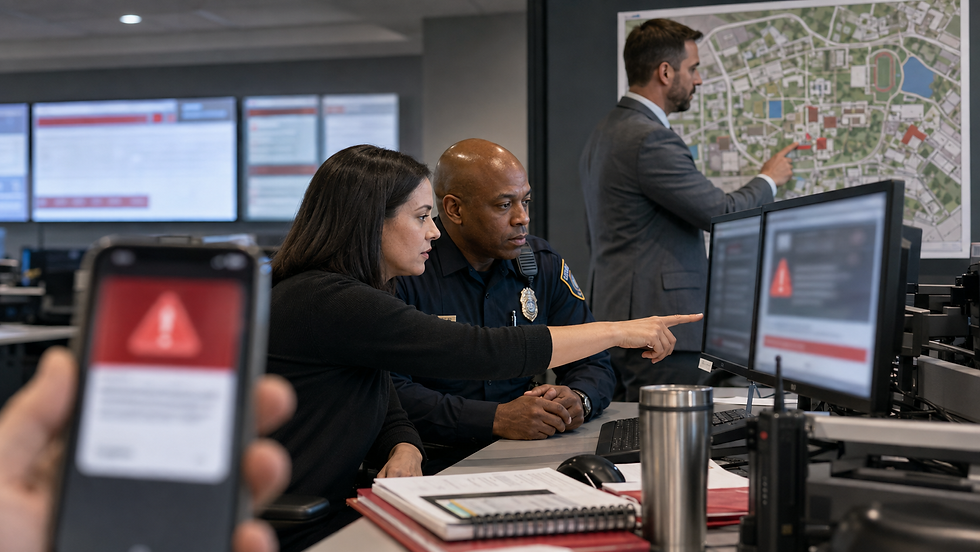
From Notification Technology to Human Readiness
The emergency communication market is expanding rapidly. One industry analysis valued the United States mass notification systems market at $3.45 billion in 2024 and projected annual growth of 18.9 percent from 2025 through 2030. Grand View Research
That growth reflects real demand, but technology should not be confused with preparedness.
A university may be able to send thousands of text messages in seconds. The more important questions are:
Who decides when the message is sent?
How quickly can that decision be made?
Is the message understandable under stress?
Does it reach people with disabilities or language barriers?
Are visitors, contractors, and families included when appropriate?
Do recipients know how to respond?
Can the system function when cellular networks are overloaded?
Has the institution practiced communication across multiple threat scenarios?
The alert is only one part of the protective process. People must recognize the threat, understand the instructions, and be prepared to act.
This is especially important during an active assailant incident, when confusion and hesitation can consume critical time. The Cybersecurity and Infrastructure Security Agency provides resources for developing active shooter emergency action plans, conducting exercises, and preparing employees to respond. CISA Active Shooter Preparedness
Institutions should combine those resources with realistic, role-specific training rather than relying exclusively on annual emails or passive videos.

Five Actions That Move a University Beyond Compliance
1. Make Safety Information Easy to Find
Annual reports, daily crime logs, emergency procedures, reporting options, and victim resources should be accessible from a central campus safety page.
Information should be written for the public, not only for attorneys or compliance specialists. A technically accurate report provides limited value if students cannot understand or locate it.
2. Train the Entire Reporting Network
Campus safety information may originate with police officers, resident assistants, athletic personnel, faculty members, counselors, student organization advisers, or human resources staff.
Training should explain:
Which incidents must be reported
Where reports should be directed
What information must be preserved
What privacy protections apply
Why prompt reporting matters
Staff should understand that forwarding information is not the same as conducting a criminal investigation. Their responsibility is to ensure information reaches the appropriate authority.
3. Exercise Decision Making, Not Just Equipment
A notification system test confirms that technology operates. It does not necessarily confirm that leaders can make timely decisions under pressure.
Tabletop and scenario-based exercises should test:
Threat confirmation
Message authorization
Communication with local responders
Conflicting or incomplete information
Rumors and social media activity
Continuity of operations
Family and media inquiries
Recovery and reunification
The exercise should conclude with documented findings, assigned corrective actions, responsible personnel, and completion deadlines.
4. Build a Visual Campus Planning Resource
Emergency plans are more useful when responders and decision makers can clearly understand the physical environment before an incident occurs. Traditional floor plans provide important information, but they may not fully communicate sightlines, room configurations, entrances, stairwells, hallways, obstacles, and potential evacuation routes.
CSI360 can be used to create interactive 360-degree image tours of campus buildings and critical locations. These visual tours can support planning for residence halls, classrooms, laboratories, athletic facilities, administrative buildings, and large gathering spaces.
During authorized planning sessions or exercises, campus officials and public safety partners can use a CSI360 tour to:
Review entrances, exits, hallways, and stairwells
Examine room layouts and potential evacuation routes
Identify locations that may create access or communication challenges
Discuss emergency notification, shelter, evacuation, and reunification plans
Familiarize responding agencies with unfamiliar campus buildings
Conduct tabletop exercises using a shared visual representation of the location
Document facility changes that may affect emergency operations
A 360-degree tour does not replace an on-site assessment, current floor plans, physical security evaluations, or responder training. It provides an additional planning resource that can help participants understand the environment and conduct more informed discussions.
Access must also be carefully controlled. Campus imagery may reveal sensitive information about building layouts, access points, security systems, or protected areas. Universities should establish clear policies governing who may create, access, update, export, and share each tour.
When properly managed, CSI360 can help transform emergency planning from an abstract discussion into a location-specific visual exercise.

5. Publish Evidence of Improvement
After an exercise or significant incident, institutions should communicate what can responsibly be shared:
What was tested or reviewed
What worked
What needs improvement
What corrective measures are underway
When progress will be reassessed
Not every tactical detail belongs in a public report. However, silence can create the impression that nothing was learned or changed.
Accountability becomes credible when people can see evidence of progress.

Protect, Prevent, Prepare
Connie Clery’s legacy reminds us that public safety leadership is ultimately an act of service. Institutions do not own safety information. They hold it in trust for the people they serve.
Universities must comply with the Clery Act, but compliance should be viewed as the minimum standard. The broader mission is to create an environment in which reporting is encouraged, warnings are timely, leaders are accountable, and community members are prepared to act.
For campus administrators, law enforcement leaders, emergency managers, and training professionals, the path forward is clear:
Protect people through accurate information and coordinated response.
Prevent avoidable harm through reporting, threat recognition, and early intervention.
Prepare the campus community through realistic planning, training, and exercises.
Triple R Investigations supports universities and public safety organizations seeking to strengthen transparency, emergency planning, and institutional preparedness. Through CSI360 interactive 360-degree image tours, immersive AR and VR training, public safety consultation, and investigative expertise, TRI helps organizations better understand their environments and turn written plans into practical, location-specific strategies.
Contact Triple R Investigations to discuss using CSI360 to document campus facilities, support tabletop exercises, and strengthen collaborative emergency planning.
Because a safety plan should do more than satisfy a requirement. It should help people understand the environment, anticipate challenges, and prepare to respond.


Comments