
Beyond the Scene Photo: How CSI360 Turns Forensic Scenes Into Interactive Training and Review Environments


A forensic scene is more than a collection of photographs.
It is a space filled with decisions, observations, evidence relationships, documentation challenges, and investigative meaning. Every room, hallway, vehicle, roadway, exterior scene, and training environment tells a story. The challenge for forensic specialists is not simply capturing that story. The challenge is preserving it in a way that others can understand, review, teach from, and explain.
For years, crime scene documentation has relied on photographs, notes, sketches, diagrams, measurements, reports, and evidence logs. These tools remain essential. They are the foundation of professional scene processing. However, they can also be difficult for others to experience in the same way the investigator experienced the scene.
A photograph captures a selected angle. A report describes what was observed. A diagram shows the layout. An evidence log records what was collected. But none of these, by themselves, fully recreate the experience of standing in the scene and understanding how all the pieces relate.
That is where CSI360 becomes valuable.
CSI360 gives forensic specialists a way to take a captured scene and transform it into an interactive environment for processing, training, review, education, and investigative explanation.
The future of forensic documentation is not just better images. It is a better use of the images, context, and scene information we already know how to capture.
[Suggested Visual Insert: CSI360 homepage product image showing forensic 360 imaging systems, camera kits, or CSI RoomScan.]
From Static Documentation to Interactive Scene Understanding
Traditional scene documentation is necessary, but it can be difficult to review when the information is separated across multiple formats. Photos may be stored in one folder, reports in another, diagrams in a case file, and evidence descriptions in a separate log. Each piece matters, but the full meaning of the scene can become harder to see when those pieces are disconnected.
CSI360 helps bring those pieces together into a more intuitive visual environment.
Instead of reviewing a scene as a disconnected set of images, users can move through the scene, look around, identify evidence locations, review notes, examine markers, and understand how one area relates to another. The scene becomes more than a visual record. It becomes an organized environment for learning and review.
This is especially important in forensic work because context matters. Evidence is not only about what was found. It is also about where it was found, how it was positioned, what it was near, what could be seen from that location, and how it fit into the larger scene.
CSI360 supports that type of contextual understanding.
Making a Scene Interactive
The power of CSI360 is not simply that it uses 360 imagery. The value is in what can be built around that imagery.
A captured scene can become interactive through:
Scene navigation points that allow the user to move through the environment.
Evidence markers that identify important items, locations, or observations.
Embedded notes that explain what the viewer is seeing.
Close-up photographs connected to the larger scene context.
Training prompts that ask students or investigators to make observations.
Review questions that guide discussion.
Documentation links that connect the visual scene to reports, diagrams, evidence logs, or instructional material.
Instructor guidance that helps users compare what they noticed with what they should have noticed.
This changes the role of the scene.
The scene is no longer just something that was documented. It becomes something that can be explored, taught, reviewed, and explained.

CSI360 for Scene Processing
Forensic specialists can use interactive scene environments to support the way they think through a scene.
During scene processing, investigators are constantly making decisions. They decide where to begin, what areas need protection, what evidence may be fragile, where contamination risks exist, what needs to be photographed, what should be collected, and how the scene should be explained later.
CSI360 can help organize that thinking visually.
An interactive scene can show the location of key evidence, pathways of movement, areas of interest, scene hazards, possible approach routes, and the relationship between overall, midrange, and close-up photographs. This gives students, investigators, supervisors, and reviewers a clearer understanding of the scene processing process.
The value is not just seeing what was present. The value is understanding how the scene was approached.
In training, this allows students to ask better questions:
Where would I begin?
What needs to be protected first?
What should be photographed before anything is moved?
What evidence might be missed if I only look from one angle?
What does this item mean in relation to the rest of the scene?
Those questions build better forensic thinking.
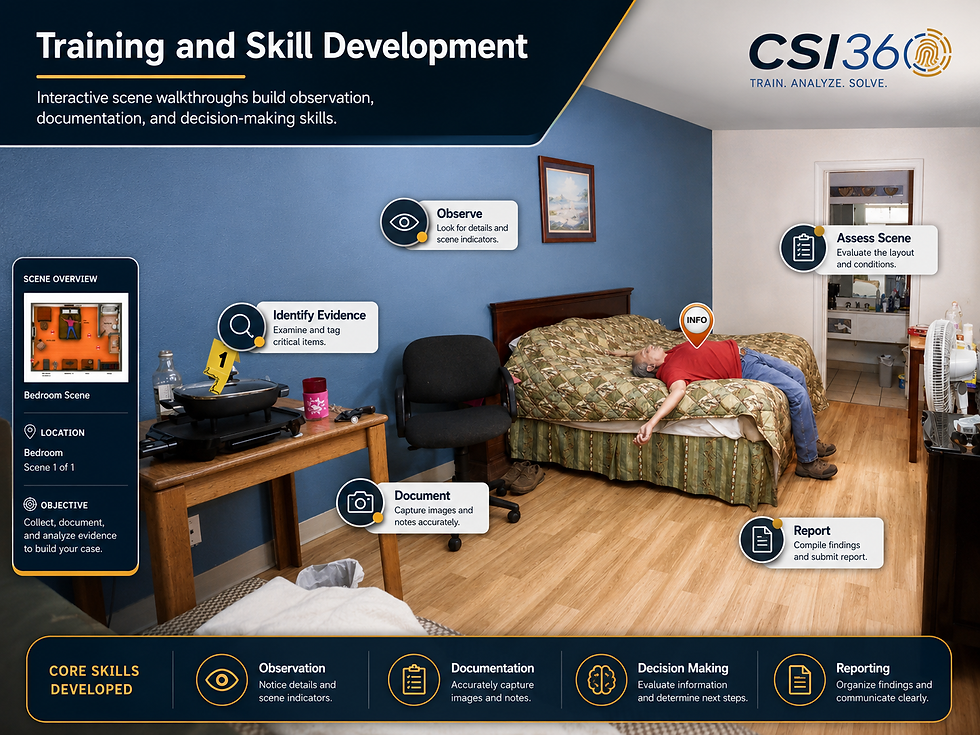
CSI360 for Training and Skill Development
One of the strongest applications of CSI360 is training.
A captured scene can become a guided learning environment where students or investigators practice observation, documentation, evidence recognition, report writing, and decision making. Instead of only looking at a slide or reading a scenario, learners can enter the scene visually and work through it.
An instructor can design learning objectives around the scene. For example, a burglary scene may focus on entry points, tool marks, trace evidence, photography sequencing, and report writing. A vehicle scene may focus on evidence location, damage documentation, occupant position, roadway evidence, and scene safety. An outdoor scene may focus on search area expansion, environmental evidence, weather concerns, and scene boundaries.
CSI360 allows the instructor to build those concepts directly into the scene experience.
The instructor can ask learners to identify evidence, explain what should be photographed, describe how they would secure the scene, identify possible contamination concerns, or write a short narrative based on what they observed.
This is where CSI360 becomes more than a technology platform. It becomes an instructional tool.
It allows students to observe before being told what to see.
That matters because forensic work is not just about knowing terminology. It is about developing disciplined observation, sound documentation habits, and the ability to explain decisions clearly.
CSI360 for Review and Quality Control
Interactive scenes can also support review.
Supervisors, instructors, detectives, prosecutors, or peer reviewers can use a CSI360 scene to evaluate how a scene was processed and documented. This can help move the review conversation from a simple report critique to a more complete discussion of scene understanding.
Instead of only asking, “What did the report say?” reviewers can ask, “What did the scene show?”
That distinction is important.
A report may describe evidence, but the interactive scene helps show the evidence in context. A student may document an item, but the scene can reveal whether they understood its relationship to the surrounding environment. An investigator may photograph several key areas, but the interactive review may show whether important transitions, boundaries, or pathways were missed.
This type of review can strengthen training and professional performance.
CSI360 can support:
Instructor's critique of student scene processing.
Supervisor review of documentation quality.
Peer discussion of scene observations.
Case preparation with detectives or prosecutors.
Report writing improvement.
Testimony preparation.
After action review of complex scenes.
In each case, the interactive environment provides a shared visual reference. Everyone is looking at the same scene, discussing the same locations, and working from the same context.
CSI360 for Education
Forensic education benefits when students can move beyond passive learning.
Students need more than definitions. They need practice. They need to observe scenes, make decisions, explain what they saw, and defend why they documented what they documented.
CSI360 helps create that type of learning environment.
An instructor can use one captured scene in multiple ways. The same scene can support an initial walkthrough exercise, evidence recognition assignment, photography planning discussion, report writing activity, courtroom explanation exercise, and final practical exam.
For example, a staged apartment scene could be used first to teach scene entry and security. Later, it could be used for evidence recognition. Later still, students could use the same scene to write a narrative report. At the end of the course, they could explain the scene as if preparing for testimony.
This approach helps students build a layered understanding.
They do not just memorize what a crime scene technician should do. They practice thinking like one.
That is the difference between technology as a visual aid and technology as an educational environment.
CSI360 for Investigative Explanation
Forensic specialists are often responsible for explaining complex scenes to people who were not there.
That may include detectives, prosecutors, command staff, students, agency leaders, or courtroom audiences. Each audience needs a clear understanding of what the scene showed and why it mattered.
CSI360 can help with that explanation.
An interactive scene allows viewers to move through the environment, see evidence locations, understand spatial relationships, and connect visual observations to the investigator’s explanation. This can be especially useful when the physical scene has changed, been cleaned, been released, or no longer exists in the same condition.
The goal is not to replace professional testimony, reports, diagrams, or photographs. The goal is to support them.
CSI360 gives forensic specialists another way to communicate context.
In forensic work, communication is part of the evidence process. If the scene cannot be clearly explained, the strength of the documentation can be weakened. Interactive visualization helps bridge that gap.
The Role of Dr. Rider and Triple R Investigations
Technology alone does not create better forensic work.
The value comes from applying technology with investigative discipline, forensic experience, and instructional purpose. That is where Dr. Ryan Rider and Triple R Investigations can help agencies, educators, and public safety professionals use CSI360 effectively.
CSI360 provides the platform. TRI helps connect the platform to the work.
That includes helping agencies determine:
What types of scenes should be captured?
How to structure an interactive walkthrough.
What evidence points should be marked?
What instructional prompts should be added?
How to connect the scene to report writing.
How to use the scene for processing and review.
How to support classroom and field training.
How to prepare the scene for explanation and presentation.
How to turn one scene into multiple learning objectives.
The goal is not to create a flashy digital scene. The goal is to improve observation, documentation, training, review, and explanation.
Technology should serve the forensic mission.
Practical CSI360 Applications
CSI360 can support a wide range of forensic and public safety training needs.
A burglary scene can become an evidence recognition and report-writing exercise.
A vehicle scene can become a crash or crime scene documentation scenario.
An outdoor body scene can become a search area expansion and environmental evidence discussion.
A patrol response scene can teach initial scene control and protection.
A classroom scenario can support student observation, instructor feedback, and peer review.
A complex scene can help detectives or prosecutors understand spatial relationships before a case meeting or courtroom preparation session.
Each application starts with the same idea:
Capture the scene, organize the context, guide the learner or reviewer, and use the environment to strengthen decision-making.
Why This Matters
Forensic specialists are under increasing pressure to document accurately, explain clearly, train effectively, and make the best use of limited resources. Agencies need tools that are practical, teachable, and aligned with real investigative work.
CSI360 helps meet that need by turning captured scenes into interactive environments that can support multiple purposes.
Processing.
Training.
Review.
Education.
Case explanation.
Courtroom preparation.
The same scene can become a stronger teaching tool, a better review environment, and a clearer communication resource.
That matters because better forensic work does not happen by accident. It happens when observation, documentation, technology, and training work together.
The Scene Becomes the Classroom
CSI360 helps forensic specialists move beyond the limitations of static photographs by transforming captured scenes into interactive environments for processing, training, review, and education.
A well-documented scene should do more than preserve what was present. It should help others understand what mattered, what was observed, what decisions were made, and how those decisions shaped the investigation.
With the right platform and the right forensic guidance, the scene becomes more than a record.
The scene becomes the classroom.
Call to Action
Interested in turning a forensic scene, training scenario, or 360 capture into an interactive learning and review environment?
Contact Dr. Ryan Rider at Triple R Investigations to discuss how CSI360 can support crime scene processing, forensic training, review, education, and investigative explanation.
#CSI360#ForensicDocumentation#CrimeSceneTraining#ForensicEducation#CrimeSceneInvestigation#PublicSafetyTechnology#TripleRInvestigations


Comments