
Reshaping Professional Training: The Transformative Power of AI and Immersive Technologies


The landscape of employee training is undergoing a rapid evolution, with Artificial Intelligence (AI) and immersive technologies leading a fundamental shift in how organizations approach learning and development (L&D). In an era where skills can quickly become obsolete, companies are investing significantly in learning and development (L&D), making AI-powered tools indispensable for efficiently and effectively upskilling their workforce. Learning is no longer a linear process but a dynamic, intelligent experience shaped by algorithms and immersion, reflecting a broader digital industrial revolution that is fundamentally altering work and social dynamics.
This post will explore how AI and immersive technologies are transforming professional training, detailing key tools, their measurable benefits, and critical considerations for successful implementation.
Key AI-Powered Learning Tools Revolutionizing Training
Several cutting-edge AI-powered tools are reshaping corporate training, making it more engaging, adaptive, and impactful.
AI-Powered Learning Management Systems (LMS)
Next-generation Learning Management Systems, such as WorkRamp, have transformed corporate training, supporting millions of learners since 2015. These platforms integrate AI for enhanced capabilities, including:
AI Assist for instant content creation, brainstorming, editing, image generation, and captioning.
AI Practice to help employees refine skills through real-time feedback.
AI Guide Translation supports learning material in up to 49 languages for a personalized experience.
AI Guide Creation, capable of drafting entire course outlines from uploaded documents and presentations.
WorkRamp, for instance, offers an all-in-one LMS solution that delivers measurable results, evidenced by Reddit decreasing sales ramp time by 33% and improving employee NPS by 13 points. In comparison, Handshake doubled revenue and decreased ramp time by 33%.
Conversational AI Software
AI-driven conversational training tools analyze learner behavior in real-time, adapting content based on individual progress. Research indicates that AI-based training programs can boost knowledge retention by 40% and increase productivity by 50%. These tools provide:
Adaptive Learning Paths that customize training to focus on weaker areas.
Multi-Modal Content Delivery, combining videos, interactive exercises, and simulations.
AI-Powered Support via chatbots that offer instant coaching, answer questions, and guide learners. For example, Zenarate AI Coach tailors learning through visual dashboards, recorded examples, and interactive role-playing exercises, addressing inefficiencies that historically led to nearly 50% of corporate training efforts being wasted.
AI Training Content Generators
These tools can produce interactive lessons, quizzes, and videos in minutes, a process that traditionally took weeks to complete. Companies utilizing AI for content creation have reported a 34% reduction in training time and a 41% increase in knowledge retention. Key advantages include:
Automated Development of relevant training materials based on roles and objectives.
Multi-Language Support for global teams.
Data-Driven Improvements by analyzing engagement to enhance content effectiveness. It is recommended to treat AI as an assistant, leveraging its ideas while double-checking and refining content with human teams. Platforms like ThingLink offer new AI-assisted creation flows, enabling non-technical users to generate professional-quality immersive learning assets and virtual tours rapidly from prompts or existing documents. This includes instantly generating educational field trips and transforming operational and compliance training into engaging experiences.
AI Teaching Assistants
AI teaching assistants offer on-demand, personalized support that integrates seamlessly into existing workflows. It is projected that 40% of people will use these assistants daily, with 60% incorporating them into their routine.
Palo Alto Networks' CaiBot achieved an 80% satisfaction rate in answering employee questions.
Forsyth Technical Community College's AI Chatbot handled 79% of student inquiries, significantly boosting response rates and reducing the number of calls. Such chatbots provide real-time, personalized guidance tailored to individual needs, allowing professionals to curate their own learning experiences.
Learning Data Analysis Tools
AI-powered analytics are transforming how organizations measure training success, moving beyond basic completion rates to track real progress and adjust strategies for better outcomes. These tools:
Identify skill gaps and personalize training accordingly.
Track performance metrics to measure success.
Link training data directly to business impact, demonstrating ROI. Walmart, for instance, saw a direct boost in employee performance and customer satisfaction after integrating an AI-powered learning tool into its tech training.
AI-Powered VR Training
AI-driven Virtual Reality (VR) is revolutionizing learning by offering immersive, real-world simulations where AI adapts scenarios in real-time and provides personalized feedback, significantly boosting retention. This approach is 76% more effective than traditional methods.
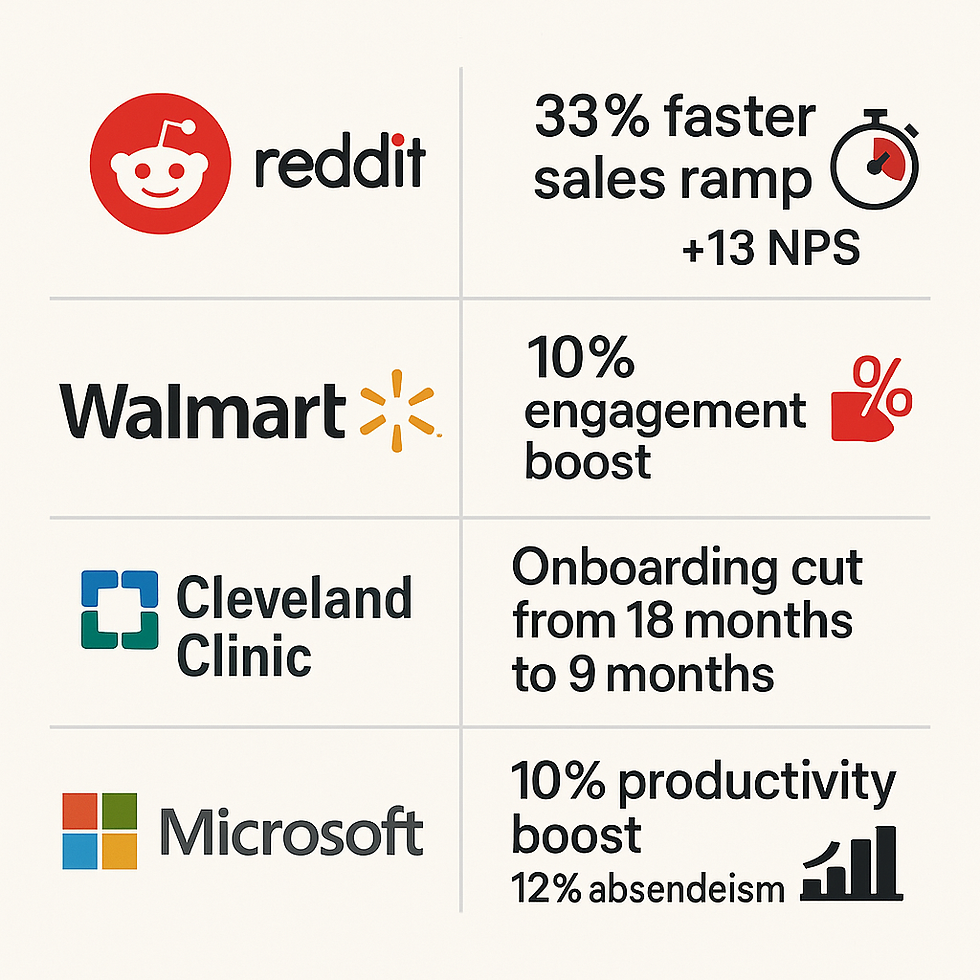
Walmart's AI-VR program increased employee engagement by 10% and reduced staff turnover by 20%.
Cleveland Clinic's VR training reduced onboarding time from 18 months to 9 months. The power of AI in VR learning lies in personalized learning paths that adapt to the difficulty of content, real-time feedback from AI-driven avatars, and efficient content creation through the use of generative AI. Companies like Treedis, Strivr, FundamentalVR, Mursion, and Virti specialize in providing such immersive training solutions.
Game-Based Learning with AI
Gamification, enhanced by AI, is transforming employee training into highly engaging experiences. Research indicates that 83% of employees feel more motivated with game-based learning, and knowledge retention can improve by up to 40%.
Walmart introduced short, AI-driven games in distribution centers, increasing participation among over 75,000 employees.
Microsoft's call center AI gamification resulted in a 10% increase in productivity and a 12% decrease in absenteeism. AI gamification adjusts challenge levels in real-time, offers personalized learning paths, and provides instant feedback, reinforcing knowledge retention.

Tools for Learning
Benefits of AI and Immersive Technologies in Training

The integration of AI and immersive technologies brings a multitude of benefits to professional training:
Personalization and Adaptive Learning: AI systems analyze user behavior and performance data to deliver tailored content and learning paths, reacting to the learner with feedback and challenges. This personalization can lead to a 55% increase in employee satisfaction and a 43% boost in engagement.
Enhanced Efficiency and Speed: AI reduces training time, with AI content generators shortening development time by 34%. Virtual learners often complete training four times faster than those using traditional methods.
Improved Engagement and Retention: AI-powered tools make training more engaging, adaptive, and impactful, boosting knowledge retention by up to 40% with conversational AI and game-based learning. Learners in VR settings report feeling up to 275% more confident in their skills.
Scalability and Global Deployment: AI-powered systems can be deployed globally and support multiple languages, enabling data-driven iteration for continuous improvement.
Cost Efficiency: While initial investments may be considered, these technologies offer significant long-term savings by reducing travel, facility, and equipment costs. For example, VR immersive learning can be more cost-effective at scale.
Risk-Free Practice: Immersive technologies offer safe environments for practicing skills, managing complex situations, and experiencing outcomes without real-world consequences, which is crucial for high-risk industries.
Data-Driven Insights: AR and VR platforms can collect granular data on every interaction, providing insights into areas for improvement and content effectiveness. This enables the tracking of performance and linking training data to its business impact.
Ethical and Practical Challenges in Adoption
Despite the tremendous potential, the adoption of AI and immersive tools in learning presents urgent ethical and practical challenges:

Bias in Algorithms: AI systems, if not carefully designed, can reinforce stereotypes or exclude specific user profiles.
Data Privacy and Security: Learning platforms collect sensitive behavioral data, making responsible management and robust security measures crucial for compliance with laws such as GDPR, HIPAA, or CCPA.
Human Disconnection: There is a risk of replacing human connection with automation; trainers must learn to integrate AI, not substitute human interaction.
Skills Gap in Implementation: Many trainers and HR professionals may lack the necessary skills or frameworks to effectively apply these tools.
Technological Infrastructure: Ensuring adequate high-speed internet, bandwidth, and compatible hardware is essential for supporting these advanced technologies.
Accessibility Concerns: Designers must consider adjustments for users with visual impairments, deafness, or hearing loss, physical disabilities, sensory overload, and epilepsy to ensure inclusivity, adhering to standards such as the ADA and WCAG.
Addressing these challenges requires consciously leading the integration of technology, thinking critically about who benefits, and designing learning that is inclusive, ethical, and future-ready.
Conclusion: The Future of Learning is Immersive and Intelligent
AI-powered learning tools are fundamentally changing how companies train their employees, setting a new standard for team development. The global AI market is projected to reach $826.73 billion by 2030, indicating significant opportunities for personalized and effective training programs. Immersive learning, through its combination of technical architecture and engaging content, serves as a powerful tool to bridge educational gaps, drive behavioral change, and enhance workplace connectivity.
The future of workplace learning is already unfolding, characterized by immersive, intelligent, and personalized experiences. Organizations that embrace these transformative technologies will gain a competitive edge, ensuring their workforce is skilled, motivated, and prepared for the challenges ahead. The critical question is not whether organizations can afford to adopt immersive training solutions, but whether they can afford not to.

Keywords: AI-powered training, Immersive learning technologies. Virtual reality training (VR training), Augmented reality training (AR training), AI in corporate training, AI learning management systems (AI LMS), AI for workforce development, Conversational AI in training, AI training content generators, AI teaching assistants

Excellent breakdown and insights.