
Building Safer Schools: A Comprehensive Blueprint for Prevention, Protection, and Recovery

Beyond the Headlines – Understanding the Reality of School Safety
The fear is real. For communities, for educators, for parents. When we read headlines about mass shootings, Parkland, Uvalde, and other tragedies, the emotional impact is undeniable. But as we confront that fear, we must also ground our strategy in facts. The first step toward smarter, sustainable safety is clarity.
Busting the Myth of the “Epidemic”
Mass shootings are indeed among the most horrifying events a school community can face. But they are not representative of everyday risk, and acting as though they are can lead to overreactions that erode trust and morale.
Decades of data show that overall school crime has decreased sharply since the early 1990s. ERIC+2CUNY Academic Works+2
For example, between 1992 and 2013, the student victimization rate (violent and nonviolent) fell by about 70%. ERIC+2CUNY Academic Works+2
Importantly, school shootings account for less than 3% of all youth homicides—meaning that 97 percent of youth violence occurs outside the school setting. National Institute of Justice+1
The conclusion is clear: While schools are not immune to violence, panic-driven responses won’t make them safer. Instead, safety must be built on proactive, layered systems that balance prevention, protection, and recovery, without sacrificing the culture and mission of learning.
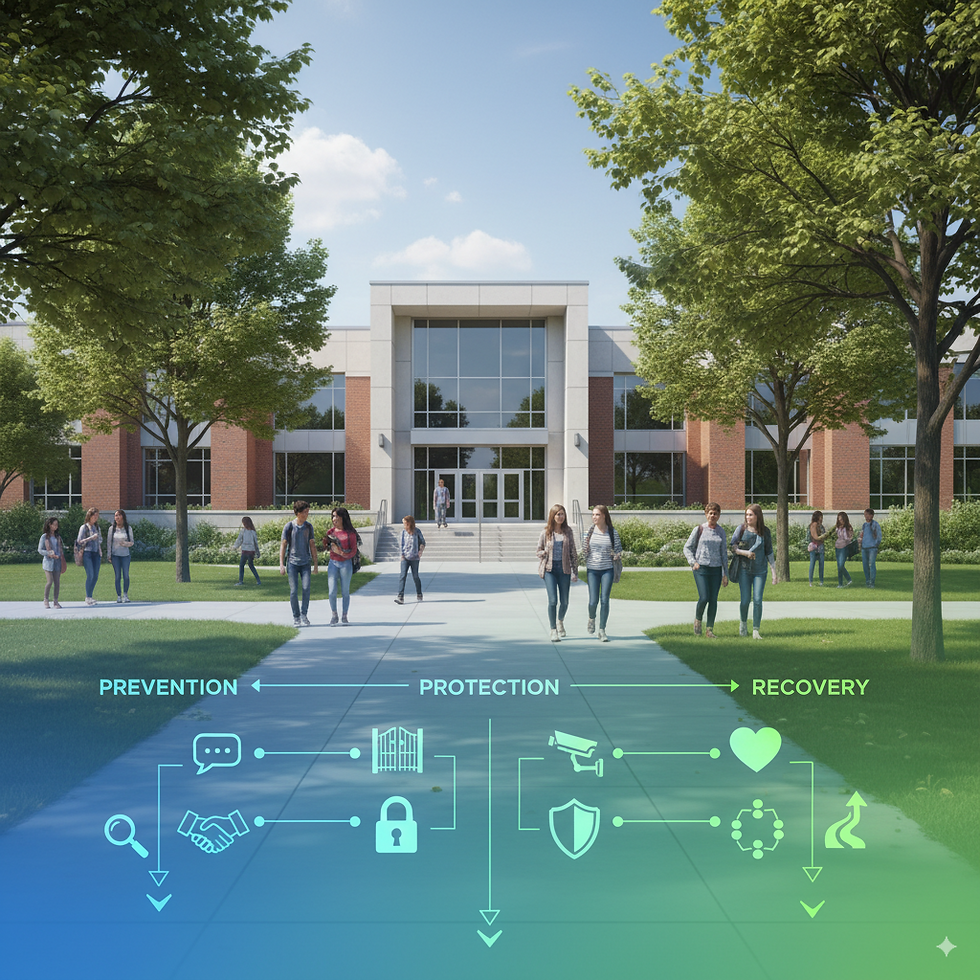
Thesis statement: A truly safe school is not a hardened fortress; it is a connected community backed by systems of prevention, reinforced defenses, and practiced response. This guide offers a blueprint across those three domains to help school districts and stakeholder networks build safety from the ground up.
The Foundation: Stopping Violence Before It Starts
Proper safety begins long before a crisis. It begins when patterns shift, when relationships strain, and when systems can detect and intervene.
Behavioral Threat Assessment: The Cornerstone of Prevention
Why threat assessment matters. Research and practice increasingly show that most targeted acts of violence do not emerge suddenly; they develop over time. Behavioral threat assessment (BTA) processes aim to identify concerning behaviors, assess the level of risk associated with them, and intervene before violence occurs.
Importantly, threat assessment is proactive, not punitive. It is not about criminal profiling or stigmatizing students, but detecting patterns of stress, communication, and escalation.
There is no accurate “profile” of the perpetrator, so the focus must remain on observable behaviors and communications, not demographic traits.
Establish a multidisciplinary team. To function well, a threat assessment system must combine diverse perspectives:
School administrators are familiar with schedules, policies, and trends.
Mental health professionals (counselors, social workers, psychologists) can assess stressors, mental health risks, and mitigation.
Law enforcement or SROs bring insight into threat behavior, legal context, and safety planning.
This team collaborates to review cases, assess risk and protective factors, and develop targeted interventions. In successful systems, the goal is not punishment, but relatively early support, including counseling, mentoring, academic accommodations, or referrals.
Breaking the “Code of Silence” Through Reporting

One of the strongest preventive levers is the disruption of “leakage”—the phenomenon by which many attackers reveal their intent to a peer or staff member before taking action. If we can encourage reporting, we can prevent escalation.
Studies show that in most incidents, perpetrators communicated their intent to someone in advance.
A culture of silence or fear of reprisal often suppresses these signals.
Action steps:
Deploy a centralized, anonymous reporting system (e.g., tip lines, mobile apps, web portals). Tools like FortifyFL offer models.
Promote the reporting system widely through posters, announcements, and digital media to students, parents, and staff.
Train all stakeholders on recognizing red flags (threatening social media posts, changes in behavior, fixation on violence) and the assurance that reports will be taken seriously and handled with care.
Cultivating a Positive School Climate
Prevention is also cultural. A school in which students feel connected, valued, and heard is far more resilient.
A positive climate reduces bullying, lowers social isolation, and encourages trust between students and adults.
Students who perceive the school as fair and responsive are more likely to turn to adults with concerns.
Best practices:
Establish peer mentoring, restorative justice, and social–emotional learning (SEL) programs.
Include student voice in decision-making (e.g., school safety councils).
Monitor and respond to micro-aggressions, harassment, and exclusionary behaviors before they escalate.
The Shield: Creating Layers of Physical Defense
Once prevention is in place, we must also build robust physical systems that slow or stop an attack. But these systems must be strategic, not reactive.
The Strategy — Defense-in-Depth
Before purchasing security hardware, every school should begin with a formal risk and vulnerability assessment. That ensures investments align with real needs, rather than being driven by trends or panic buying.
The layers of defense model helps structure that strategy:

Outer Layer – Campus perimeter: fencing, gates, landscaping, lighting, surveillance.
Middle Layer – Building Exterior: Controlled Entryways, Visitor Screening, Badge Systems.
Inner Layer – Interior and Classrooms: Door locks, safe zones, hardened doors, and interior monitoring.
Each layer supports the others. A breach in one doesn’t mean a total failure.
Hardening the Perimeter and Building Access
Lesson from Parkland: Unstaffed or unlocked perimeter gates are a known failure. Schools must control campus access.
Action steps:
Establish a single point of entry: funnel all visitors through one entrance equipped with check-in stations and staff monitoring.
Utilize visitor management systems integrated with local databases (e.g., sex offender registries, restraining orders) to flag concerns in real-time.
Secure or lock other entrances, and deploy surveillance or access control to monitor them.
Securing the Classroom
The classroom is the last line of defense and critical.
Doors must lock from the inside. Teachers should never have to risk exposure in a hallway to lock their door.
Every classroom should maintain a designated “hard corner”: a safe area, not visible from the door window, free of furniture, where occupants can gather during an emergency.
Periodic checks should ensure doors, hardware, and sightlines remain functional and clear.
The Playbook: Planning, Practice, and Partnerships for an Effective Response
When prevention and defense fail, a well-rehearsed and collaborative response can save lives.
Developing a High-Quality Emergency Operations Plan (EOP)
An EOP must be comprehensive and flexible.
Adopt an all-hazards mindset: cover natural disasters, fires, hazardous materials, and violence, not just active shooters. Office of Justice Programs
Follow the 6-step planning process:
Form a planning team
Assess hazards and risks
Set goals and objectives
Develop, draft, and write the plan
Review, revise, and approve
Implement, maintain, and update
Structure the plan as:
Basic Plan: mission, concept of operations, roles
Functional Annexes: lockdown, evacuation, reunification, communication
Hazard-Specific Annexes: for specific threats (e.g., tornado, shooter)
Importantly, the EOP must be developed collaboratively with staff, law enforcement, first responders, mental health agencies, and even parent representatives. Office of Justice Programs
Practice Makes Prepared: The Critical Role of Drills
A plan that is never practiced is a plan destined to fail. The Parkland response suffered in part because Marjory Stoneman Douglas High School had no Code Red drills in the year prior. American Enterprise Institute+1
Best practices:
Conduct regular, realistic drills (lockdowns, evacuations, reunification) involving students, staff, and first responders.
Use scenario-based injects (unexpected variables) to test adaptability.
Tailor language and expectations by age (younger students can’t absorb full tactical jargon).
Debrief after each exercise, capture lessons learned, update the EOP, and repeat.
The “Whole Community” Approach to Safety
Safety is not the sole responsibility of school staff—it is a community-wide responsibility.
Establish relationships and engage in joint planning with law enforcement, fire/EMS agencies, mental health organizations, parent groups, and local government officials.
Overcome information-sharing barriers by understanding that FERPA and HIPAA do allow health and safety exceptions, particularly when imminent harm is at stake.
Deeper Dives: Four Critical Angles You Can’t Afford to Ignore
To go beyond the basics, these four domains demand attention.
Empowering Students as Partners, Not Just Reporters
Don’t stop at “See Something, Say Something.” Students can be co-creators of safety.
Encourage peer mediation, student-led climate teams, and youth safety councils.
Embed leadership roles for students in threat assessment committees or safety planning groups.
This fosters ownership and often surfaces earlier signals than adult monitoring alone.
The “School as Fortress” Debate — Balancing Security and Learning
Too much hardening can turn a school into a fortress, alienating the very students you aim to protect.
The Columbine Commission argued that excessive physical hardening was not the priority; relationships and climate matter more.
Overemphasis on surveillance, metal detectors, and barriers may erode trust, increase anxiety, or disproportionately impact marginalized students.
The goal must be balance: security that supports learning, not dominates it.
The Marathon After the Sprint — Planning for Long-Term Emotional Recovery

Crisis response often ends with reunification and lockdown, but trauma doesn’t.
Schools must plan for years of recovery—not just hours or days.
Integrate Psychological First Aid (PFA), sustained counseling, teacher support, and community engagement into post-event plans.
Mental health support must be normalized and integrated into annual budgets and contracts, rather than being added in crisis mode.
The Unseen Cyber Threat to Your Physical Security
In an era of networked cameras, access control, and visitor management systems, cybersecurity is paramount to safety.

Security systems can be hacked or disabled. Attackers may seek backdoor access, launch denial-of-service attacks, or manipulate camera feeds.
Best practices:
Segment security networks from general-use networks
Enforce strong encryption, frequent firmware updates, robust access controls, and intrusion detection
Conduct cyber penetration testing as part of the vulnerability assessment
Conclusion: A Culture of Safety Is an Ongoing Commitment
Key Takeaways
Prevention, protection, and recovery must be integrated—not siloed.
Schools must invest in behavioral threat assessment, a favorable climate, and effective reporting systems well before a crisis occurs.
Physical defenses matter, but only when grounded in strategic vulnerability assessment.
An EOP without practice and partnerships is an illusion.
Ultimately, the deepest strength lies in culture, encompassing trust, relationships, shared responsibility, and resilience.
Call to Action
Use this blueprint as a starting point in your community. Begin by forming a multidisciplinary planning team and commissioning a comprehensive risk assessment. Start conversations with law enforcement, mental health agencies, student groups, and parents. Bring this framework to your next safety or board meeting.
Final Thought
Technology, doors, and drills matter. But they are tools. The ultimate foundation of safety is the people. The daily relationships, the respect, and the shared commitment to every student's well-being are what protect, prevent, and prepare. If we invest in systems and culture, we can build schools that are not only safer but also truly resilient.


Comments